Time tested teaching tool | Lakeview teacher uses typewriters to teach writing to students
Published 2:06 pm Wednesday, December 3, 2014
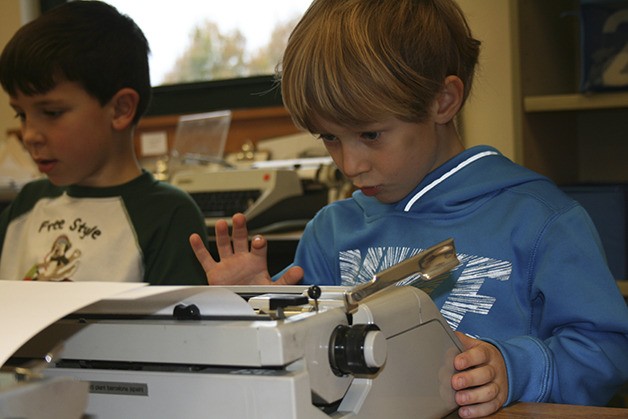
At 11 a.m. every day in Room 112 at Lakeview Elementary it sounds like a newsroom from the 1900s. Rather than scribbling with pencils, pens or even laptops, the students in Brad Coulter’s first grade class hone their writing and spelling skills with the use of the original word processor – the typewriter. With printed words on the walls in front of them, the students work on writing assignments, such as small-moment topics assigned by Coulter. When they’re finished, they hand him their finished work complete with crossed out mistakes designed to teach them how to write without the aid of electronic tools such as autocorrect and spellcheck. At the beginning of each week they are assigned a typewriter, ranging from the large Royal to the Lettera 32 Olivetti manual – the same one used by author Cormac McCarthy – which is selected from notecards.
The unusual teaching method came from Coulter’s own experience writing with his father’s old Olympia typewriter while at college.
Though computers, laptops and now electronic tablets left them obsolete, he says he still has a fondness for the machines.
“I’ve always had a thing for typewriters,” he said. “There’s just something magical about it.”
He got the idea of bringing typewriters into class after seeing how his students reacted to them with natural curiosity and fascination. Because they are purely mechanical, aside from one electronic typewriter he found in a garbage dump on Lopez Island, he said there’s little instruction or training required to use them.
In fact, allowing them to explore the devices is one of the things that has made it such a success with students.
A typewriter collector, Coulter amassed them gradually through eBay and Craigslist. Though many of them list at a high price, he said he snatches them up for $20-30, and on Craigslist he doesn’t have to pay for shipping.
“I’m crazy about them,” he said. “I also have sort of a collector gene. It’s sort of a dangerous hobby.”
It’s a hobby that has piqued the interest of the students, some of whom have had their parents get them a typewriter to use at home. When asked what they enjoyed about typing, the students said they liked the staccato rhythm it makes when they type and it was easier to write than doing it by hand. As part of their assignments, they have written poetry and short stories, which Coulter keeps in a binder.
Another advantage the typewriters offer is their durability and lack of maintenance.
Aside from having to replace the ink ribbons, which he orders from a company in California, he said the machines run without any troubles. The yougest model is at least 30 years old and some of them are from the 1930-50s.
Although the students are free to write in journals instead of type, Coulter said the majority of students choose the latter.
Not only is it enjoyable for them to type, he said, but it helps improve specific skills, such as spelling, grammar and punctuation.
Without autocorrect or spellcheck, the mistakes cannot be deleted or erased. At the same time, Coulter tells students not to start over with a fresh sheet of paper and instead leave the mistakes and cross them out.
Doing so, he said, gives them the freedom to make mistakes and continue writing, while teaching them to give more thought to what they write.
“Without spellcheck, they have to really sound out the words,” he said. “When you have to commit to the letter you think more about it.”