March on down to Fort Warden for great camping | Hiking the Evergreen State
Published 11:15 am Monday, July 13, 2026
Editor’s note: As in summers past, we’ll be spending time during July and August focusing on the great outdoors: namely, some of the noteworthy campgrounds and trails found in the Evergreen State – and maybe just a few opportunities for a good, long walk. Most of the of the destinations will be within a reasonable driving distance from our part of the Puget Sound region. This series will, hopefully, provide encouragement to enjoy life outside – whether pitching a tent or “glamping” in a luxurious motor home, whether walking a paved pathway or mountain trail.
This series began with a look at the Nisqually Wildlife Refuge. Today brings a report from Fort Warden State Park. After that, the only certainty is that it will be outdoors.
All campgrounds and trails were visited recently by the author, his wife and Rosie, a great dog. They aren’t exactly roughing it these days, having long ago abandoned a tent for a travel trailer.
As far as campgrounds go, Fort Warden offers more than most. Is that always a good thing? It depends upon individual tastes and expectations.
Formally known as Fort Warden Historical State Park, the 434-acre, multi-use destination cannot be beat when it comes to location. In the upper-right corner of mostly primitive Jefferson County, the park begins at the Strait of Juan de Fuca shoreline and climbs to a high bluff overlooking Admiralty Inlet at the entry to Puget Sound.
Here, we’re talking camping:
The first thing to keep in mind is the popularity of this place; you’ll need a reservation and do not wait until the last minute.
Fort Warden has two options, the Beach Campground and the Upper Forest.
The Beach Campground features full-hookup sites that are mostly level and offer a fair amount of privacy (this is a relative term, as there will be neighbors). The sites are just a short stroll to salt water.
The Upper Forest offers partial-hookup sites in a forested setting that are a bit more private.
Getting around on foot:
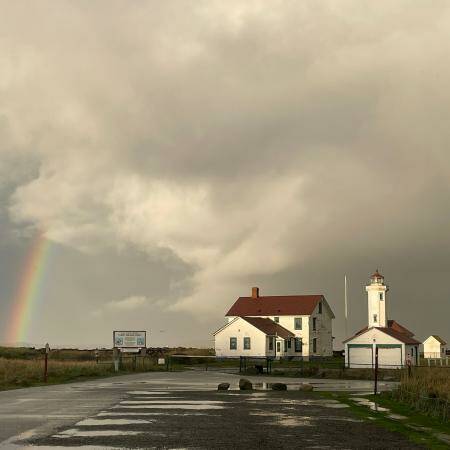
An appealing element of Fort Warden is the option of forest or beach. There are a dozen miles of trails, all offering a story of their own. Stroll the rocky beach and wind up circling the historic Point Wilson lighthouse; or continue to the wharf.
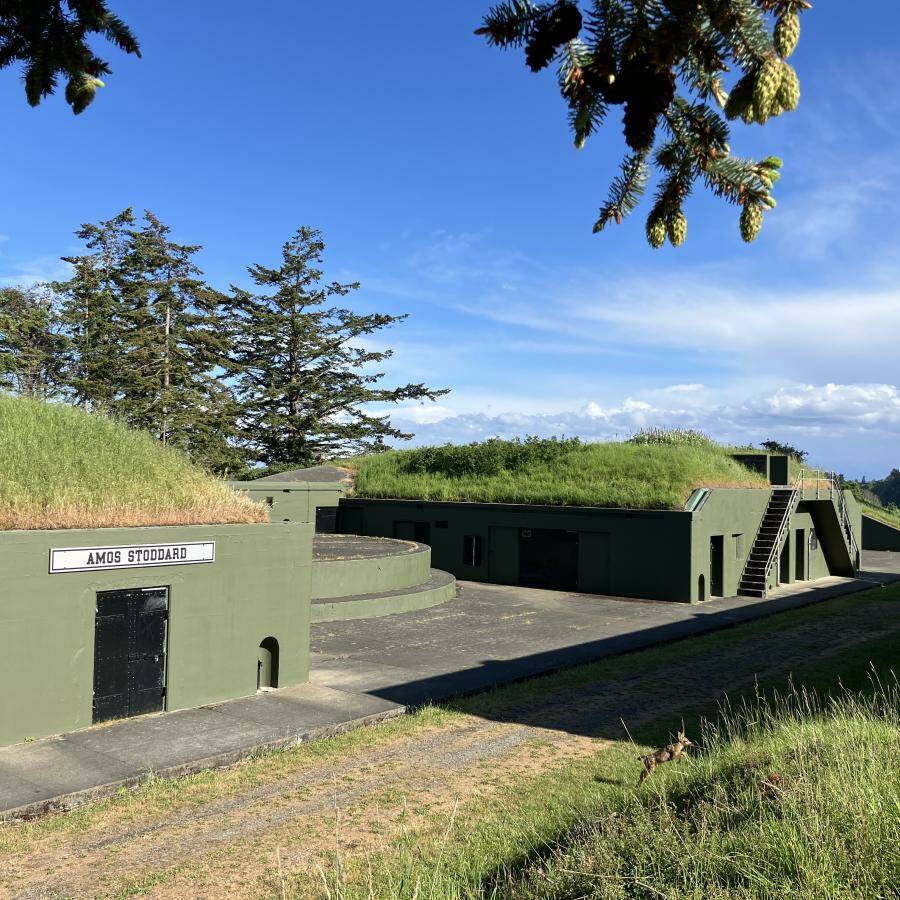
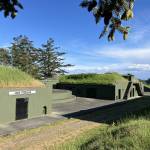
The real hiking takes one uphill, is accessible from both campgrounds and winds throughout Artillery Hill where the majority of the century-old military structures are found. Climbing over and around these concrete behemoths gives a glimpse into the national thinking a century or more ago. (More on the history in a bit.)
This was an active military installation:
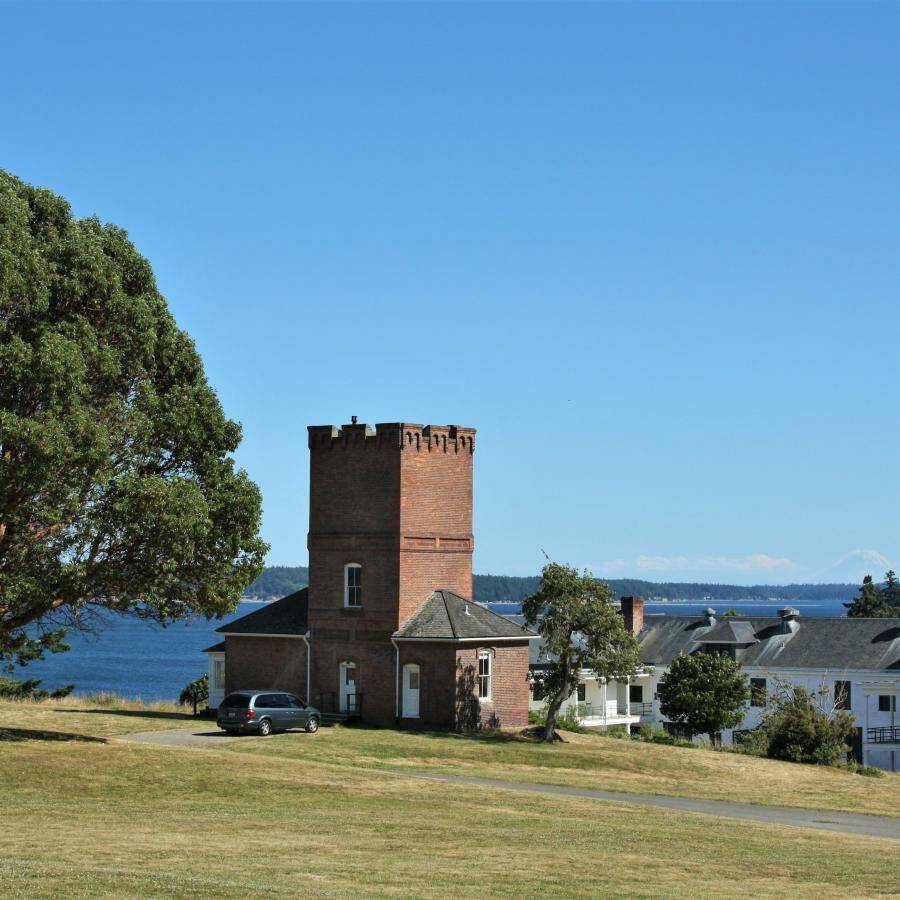
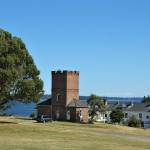
Separated a bit from the Beach Campground are the well-kept grounds and buildings that originally composed Fort Warden. Expansive parade grounds are ringed by buildings that were busy during the early half of the 1900s. A museum highlights the Commanding Officer’s Quarters and the Coast Artillery Museum tells the tale of coastal defense strategies from the late 1800s to post-World War II.
While some buildings have been given over to full-time enterprise not meant for temporary visitors, there are amenities that take Fort Warden out of the typical “campground” picture.
For example, Reveille by Planted offers year-round food service like breakfast and lunch, snacks, espresso, smoothies and more. For the 21-plus crowd, Taps and the Guardhouse offers beer, wine and craft cocktails along with food. Guests can sit on the outdoor patio or among the steel bars of the old jail cell. The Cable House Canteen provides everything from snack to firewood and Gypsy Coffee specializes in espresso drinks.
True, this is not exactly roughing it. Not even close.
Among the many sites of interest are a natural history museum and aquarium, operated by the Port Townsend Marine Science Center on the grounds of Fort Worden.
A fascinating history in Port Townsend:
Fort Worden is a prime example of the U.S. Army’s strategy for defending the region prior to the beginning of the 20th century. Home to a bluff that provides views of the Puget Sound entry, the fort was part of the Triangle of Fire that included Fort Casey on Whidbey Island and Fort Flagler on Marrowstone Island. The trio of forts were part of a system primarily aimed at protecting the Puget Sound Naval Shipyard at Bremerton.
The defense of the Sound originated in 1846 when President James K. Polk appointed a commission that should study sites from San Diego to Puget Sound. The Northwest, still a part of the Oregon Territory, was considered too remote and not worth a heavy investment.
Talks occasionally picked up, but the Civil War interrupted any planning. Fast-forward a bit to 1891 and the Naval Station in Bremerton was established, renewing interest in protecting such a valuable investment in national security. The Spanish-American War prodded the work on the three Triangle of Fire sites to protect Bremerton from the Spanish fleet.
Work at Fort Warden was slow but steady. Installation of the weaponry began in 1900 and was completed in 1901. Through the years more artillery was added, eventually resulting in 41 individual gun sites. During World War I, Fort Warden was a training ground for soldiers destined for European battlefields. Fort Worden remained an active site through World War II, with artillery replaced with anti-aircraft guns.
The fort closed in 1953 and, in 1957, the state purchased the land and buildings to be used as a treatment center for troubled youth. After the center closed the state’s Parks and Recreation Commission moved to take control, purchasing Fort Worden and officially dedicating the site as a state park in 1973.
Looking for a vacation rental?:
The buildings at Fort Warden that are open for public stays saw some rocky times in recent years. Now, things have improved.
Guests can book an overnight stay in former military housing like the fine Officers’ Row Housing to the (more modest) row of homes once occupied by non-commissioned officers. All are furnished for individual or group rentals.
For larger groups, the Reunion House has 14 private bedrooms, four bathrooms, meeting areas and a large kitchen and dining area.
The rentals are used for everything from weddings and reunions, from anniversaries to retreats.